
Published on
Meeting the researchers of tomorrow means discovering fresh perspectives on major scientific challenges. Today, Clara Piersson gives us an insight into her work on Alzheimer’s disease, the result of three years of rigorous research into the Tau protein and Electron Paramagnetic Resonance (EPR).
A young PhD graduate in physical chemistry and structural biology, Clara defended her thesis in November 2025 as part of Yann Fichou’s team (CBMN, IECB). Having completed her thesis, she is now preparing to take on new scientific challenges abroad as part of a postdoctoral fellowship.
In this interview, Clara shares her journey, her discoveries and her vision of research, covering technical challenges, rewarding collaborations and future opportunities.
Academic background and motivations
After two years of preparatory classes in physics and chemistry in Paris, I enrolled at ENSMAC (École Nationale Supérieure de Matériaux, d'Agroalimentaire et de Chimie) in Bordeaux, where I obtained my engineering degree. My interest in research took shape during a laboratory placement, an experience that revealed to me the intellectual challenge and creative freedom inherent in solving scientific problems.
Upon completing my engineering degree, however, I took the time to consider pursuing a PhD, motivated by a desire to specialise further. My initial training had focused mainly on physical chemistry and the formulation of nanopolymers, but I aspired to move towards biological and medical issues. I therefore chose research topics linked to major diseases, such as Alzheimer’s disease and cystic fibrosis.
In September 2022, I joined Dr Yann Fichou’s team (CBMN, IECB) to begin my PhD, entitled "Mechanisms of Tau protein aggregation in the presence of membranes".
My thesis forms part of research into Alzheimer’s disease and, more broadly, into a group of neurodegenerative diseases known as tauopathies, all of which are linked to the abnormal accumulation of the same protein in the brain: the tau protein. This protein naturally has no defined shape. But under certain conditions, it undergoes a phase transition and assembles into long, rigid fibres that accumulate in neurons and gradually destroy them. The focus of my thesis was on understanding how this phase transition occurs, and in particular what role the membrane lipids present in the brain play in triggering this process. To explore this, I combined two complementary techniques: RPE spectroscopy, which allows the protein to be probed at the atomic scale, and cryo-EM, which enables the direct imaging of the fibrillar structures formed. The aim ? To better understand the very earliest stages of the disease, with a view to eventually identifying new therapeutic targets.
Methodology and collaborations
At the start of my PhD, my knowledge of biology, protein production and Electron Paramagnetic Resonance (EPR) was limited. I therefore spent my first year undergoing intensive training, supervised by the laboratory engineers and my PhD supervisor.
Throughout my PhD, I had the opportunity to collaborate with EPR experts, which enabled me to broaden my experimental skills. I thus conducted experiments in several laboratories in Bordeaux (CRPP with Mathieu Rouzières, ICMCB with Mathieu Duttine) and Marseille (BIP, Infranalytics network). These exchanges not only enriched my work but also helped me build a professional network within the scientific communities focusing on amyloids, the Tau protein and EPR.
To disseminate my findings, I have authored publications and presented my work orally at conferences (e.g. the 7th International Symposium on Pathomechanisms of Amyloid Diseases) and scientific seminars.
Challenges and achievements
- What achievement are you most proud of ?
One of my main achievements was learning how to showcase my scientific findings by writing and submitting several papers during my PhD.
My work was recognised with the Electronic Paramagnetic Resonance (EPR) PhD Prize, awarded by the French EPR Association (ARPE) on 19 March 2026. This distinction is all the more significant given that EPR was not my main area of expertise at the start of my PhD, which opens up promising prospects for postdoctoral positions abroad.

Publications :
Pounot et al., JACS, 2023 (DOI: 10.1021/jacsau.3c00550)
Broc, Piersson, Fichou, FEBS Letters, 2025 (DOI: 10.1002/1873-3468.70022)
Piersson et al. Biophysical Chemistry, 2026 (DOI: 10.1016/j.bpc.2025.107550)
- What was the biggest challenge ?
I encountered several difficulties, including technical hurdles and a lack of self-confidence, particularly at the start of my PhD. Producing the Tau protein in my second year proved particularly problematic and really tested my perseverance. Fortunately, the support of those around me, both professionally and personally, was crucial in helping me overcome these challenges. These experiences taught me the importance of resilience and personal balance in research.
Life as a researcher: work-life balance, skills and advice
Right from the start of my PhD, I threw myself wholeheartedly into my work, putting in long hours. Whenever necessary, I would take a day off to switch off and recharge my batteries. This balance enabled me to stay motivated and productive over the long term.
Skills developed : scientific and transferable
My PhD provided a unique opportunity to develop a wide range of skills, both scientific and interpersonal.
In scientific and technical terms :
- Active involvement in setting up and managing the laboratory (management of waste, glassware, stock, etc.).
- Supervision of two first-year Master’s students, an experience that taught me about teaching and patience.
In cross-disciplinary and personal terms :
- Involvement in science outreach initiatives, such as a day of exchange with secondary school pupils as part of the DECLICS programme (Dialogues Between Researchers and Secondary School Pupils to Foster an Interest in Knowledge Construction).
- Involvement in the IECB’s communications and events committee, where I acted as a liaison between PhD students, postdoctoral researchers and guests at monthly seminars.
- Organisation of major scientific events: the 13th Young Scientists’ Day (YSS) in 2025 (fundraising, budget management, coordination with service providers) and the CNRS thematic school in structural biophysics in 2024.
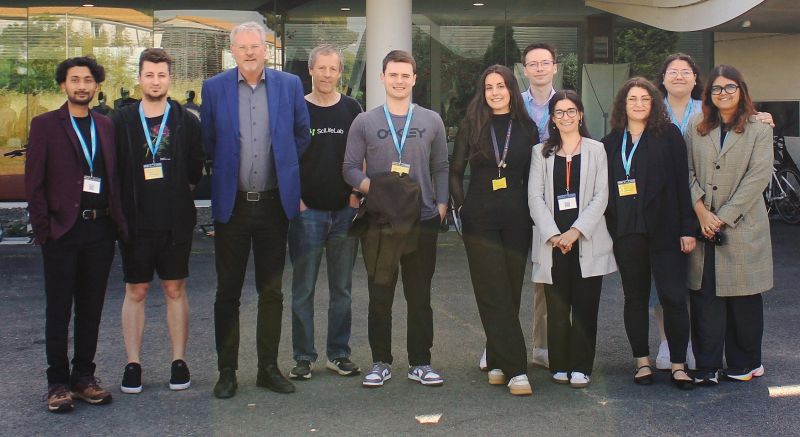
YSS 2025 Organising Committee
Although these activities were time-consuming, they did not hinder the progress of my thesis and proved to be extremely rewarding. They enabled me to expand my network and strengthen my project management and communication skills.
Advice for prospective PhD students
Before embarking on a PhD, it is essential to ask yourself the right questions:
- Why am I doing a PhD ? What are my professional and personal goals ?
- How do I intend to carry it out ? What balance between work and personal life am I prepared to accept ?
A PhD requires a considerable investment and presents a variety of challenges: technical, experimental and interpersonal. But when your motivations are clear, it becomes easier to overcome the obstacles.
My most important piece of advice :
Even though it’s a demanding journey, I have absolutely no regrets about doing a PhD. It’s an incredibly rewarding experience that helps you grow in so many ways. To anyone who’s hesitating: go for it, but be prepared to stay organised and surround yourself with the right people to succeed!
Future prospects: towards new scientific challenges
I am currently actively seeking a postdoctoral position abroad, with the aim of developing new skills and broadening my field of expertise over a period of two to three years. This step will then enable me to confidently apply for research positions, particularly at the CNRS or INSERM.
At this stage of my career, the precariousness and instability inherent in temporary positions do not concern me. On the contrary, I see this period as an opportunity to tackle new scientific challenges, push my limits and enrich my research experience. It is a step I am approaching with enthusiasm and determination, driven by a desire to learn and contribute to innovative projects.
Clara Piersson’s career path perfectly illustrates how perseverance, curiosity and a willingness to collaborate can transform a PhD thesis into a rich and rewarding scientific journey. Her work, recognised with the Electronic Paramagnetic Resonance (EPR) PhD Prize and several publications in international journals, testifies to the quality and impact of her research.
Beyond the scientific results, Clara has built a strong network across various fields — amyloids, tau protein, EPR — and has been involved in cross-disciplinary projects, ranging from science communication to event organisation. These experiences, both demanding and enriching, are now opening the door to new challenges for her, with the ambition of pursuing a career as a researcher, always driven by a passion for understanding and innovation.