
Published on
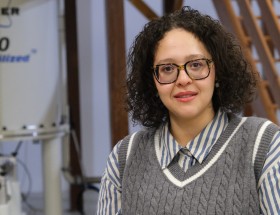
Nadia El Mammeri, CNRS Associate Researcher at the Institute of Chemistry and Biology of Membranes and Nano-objects (CBMN-UMR5248), has just joined Dr. Antoine Loquet's group based at IECB.
Nadia already knows the IECB well, having completed her thesis here between 2017 and 2020. After a master's degree in Biochemistry and Molecular Biology in Bordeaux, her thesis work focused on the study of supramolecular assemblies using solid-state magnetic resonance spectroscopy (NMR). After successfully defending her thesis, she joined Professor Mei Hong's team at the Massachusetts Institute of Technology in Boston (MIT) to study the functional and pathological forms of the Tau protein. Through this work, Nadia was able to complement and deepen her skills in structural biology and cryo-electron microscopy (cryo-EM).
- What do you take away from your American experience?
I had my first experience in the United States at Yale during my thesis (6 months) as part of a Fulbright scholarship. This exchange confirmed my decision to return to the United States for a postdoc. During my 4-year postdoc, in Professor Mei Hong's group at MIT in Boston, I studied the mechanisms of Tau protein aggregation in neurodegeneration.

- What advice would you give to future doctors?
My few months in the United States, working with Professor Jorge E. Galán's team at Yale, were very enriching scientifically, as it was my first contact with cryo-EM. Subsequently, I was able to pursue this field at MIT.
These two experiences in the USA allowed me to discover new methodological approaches to research, while consolidating my expertise in solid-state NMR. During my four years at MIT, I also gained valuable experience in laboratory management and student supervision.
I strongly recommend that students, if possible, do an exchange in another country or with another research team. It's essential to discover different ways of working and different scientific approaches in order to better define one's own career path.
- Nadia, why did you choose Bordeaux for your return to France?
Bordeaux, and in particular the IECB, has the advantage of bringing together several characterization techniques, such as cryo-EM and solid-state NMR, in a single location. What's more, my home institute, CBMN, is a multi-disciplinary laboratory bringing together chemists, biochemists and biologists, offering many opportunities for collaboration. Last but not least, the Bordeaux Neurocampus enjoys an international reputation, and my theme of studying aging with the TMEM106B protein (a protein involved in neurodegenerative diseases) fits in perfectly with Neurocampus projects. For all these reasons, Bordeaux was the best choice in France for developing my research projects.
- What are your short- and medium-term projects?
My main research project concerns the study of the TMEM106B protein and, in particular, how to answer mechanistic questions using solid-state NMR on the one hand, and structural issues using cryo-EM on the other. But before getting to the heart of the matter, my first year will be largely devoted to writing applications for national and international fundings
Contact
- EL MAMMERI Nadia - CNRS researcher
- 0540003029
- %6e%61%64%69%61%2e%65%6c%2d%6d%61%6d%6d%65%72%69%40%75%2d%62%6f%72%64%65%61%75%78%2e%66%72